

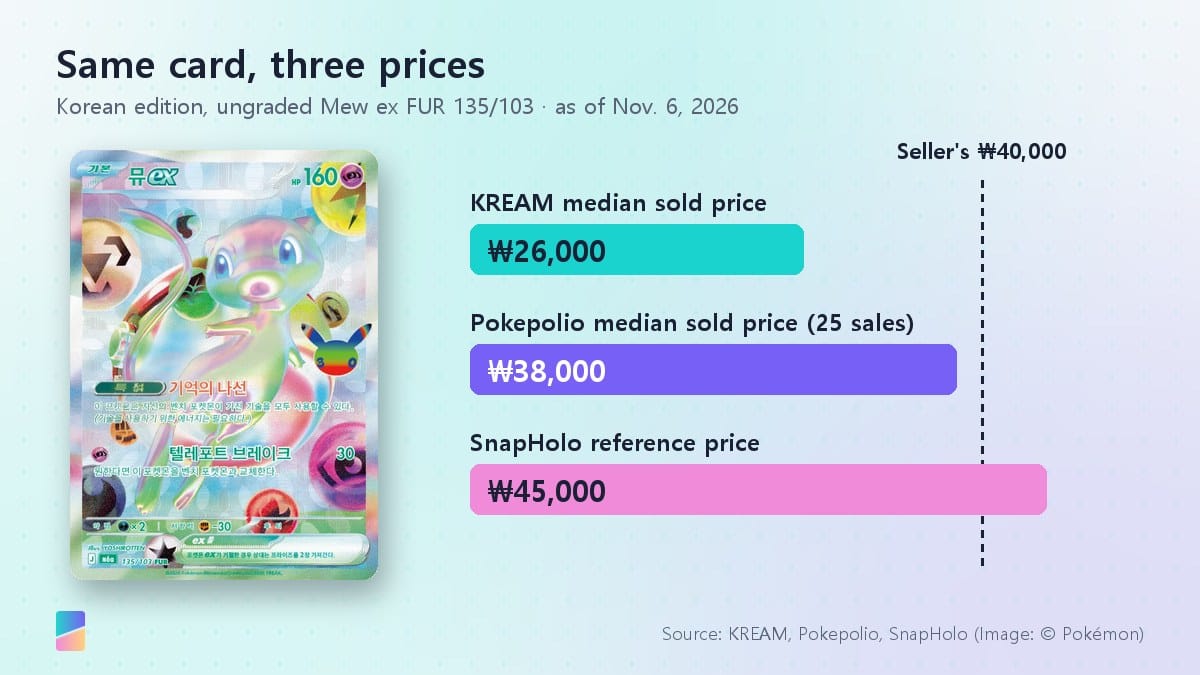
To check a Pokémon card price, search by card number, then read sold prices from the last 30 days for the same condition, along with where they sold, when, and how many times. On Nov. 6, 2026, an ungraded Korean-edition Mew ex FUR 135/103 had three different numbers: a KREAM median sold price of ₩26,000, a Pokepolio median sold price of ₩38,000 and a SnapHolo reference price of ₩45,000. We think most Korean-edition cards have no real market price, and we don't count a number as a market price unless it shows the market, the date and the sale count.
Say a seller offers that Mew ex FUR for ₩40,000. The first two numbers make it expensive and the last one makes it cheap. The last number comes from our own site, and this article questions it along with the others.
How to look up a Pokémon card price
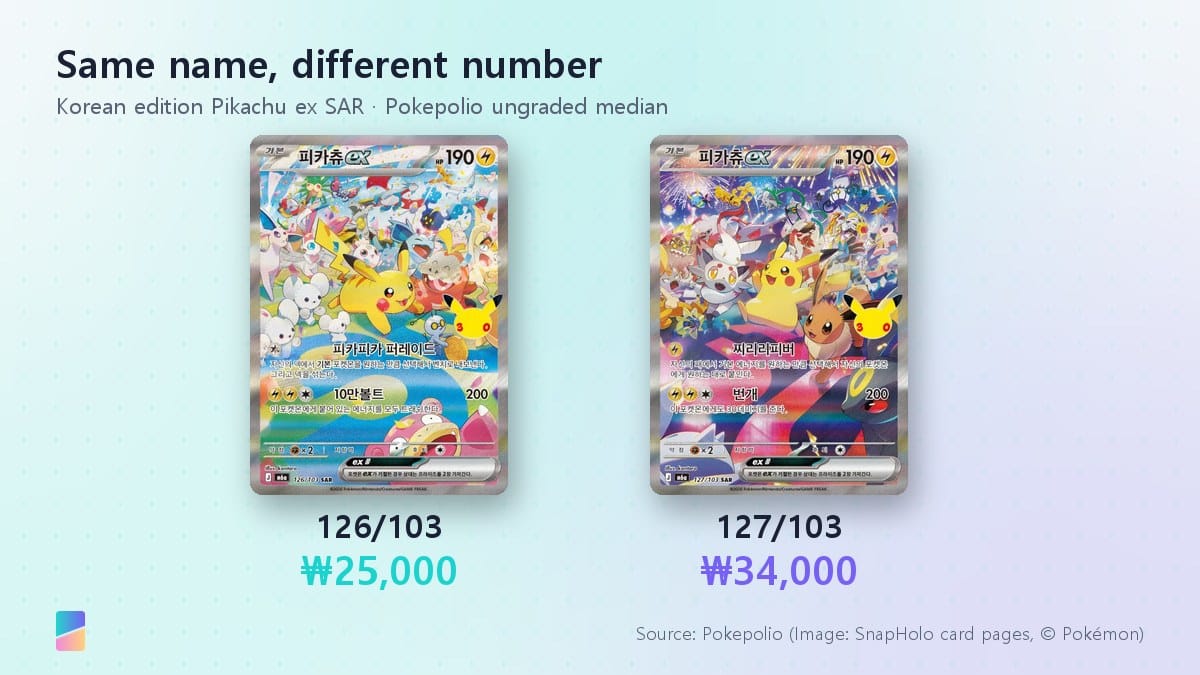
Searching by name is an easy way to land on the wrong card's price. The Korean edition of Inferno X has four Mega Charizard X ex cards in one set. Ungraded, 013/080 RR has a SnapHolo reference price of ₩1,000, 094/080 SR has a Pokepolio median sold price of ₩6,000, 110/080 SAR is at ₩155,000 and 116/080 MUR is at ₩250,000. The Korean-edition Pikachu ex SAR in the 30th Celebration set splits too: its ungraded Pokepolio median is ₩25,000 for 126/103 and ₩34,000 for 127/103. A name and a rarity aren't enough.
To price a Pokémon card, start by writing down the number in the bottom corner, the set and the language. Searching by type, with terms like "ex price," "VMAX price," "GX price" or "gold card price," won't get you an answer. On Nov. 6, 2026, the median SnapHolo reference price for ungraded Korean-edition cards was ₩2,506 across 799 ex cards, ₩5,000 across 81 VMAX cards, ₩14,467 across 343 GX cards and ₩18,000 across 90 UR cards, a rarity with many gold cards. Even among ex cards, the top 10% sit at ₩30,000 or more, so the type alone can't tell you the value.
Mew ex FUR exists only as 135/103, though, so the card number doesn't explain its three prices.
Pokémon card price gaps by market
We looked up other cards at the same three places on the same day. All of them are ungraded Korean-edition cards.
| Card | KREAM median sold price | Pokepolio median sold price | SnapHolo reference price |
|---|---|---|---|
| Charizard 137/103 (30th Celebration) | ₩63,000 | ₩65,000 (31 sales) | ₩63,000 |
| Mewtwo ex FUR 134/103 (30th Celebration) | ₩20,000 | ₩23,000 (33 sales) | ₩43,000 |
| Mew ex FUR 135/103 (30th Celebration) | ₩26,000 | ₩38,000 (25 sales) | ₩45,000 |
| Pikachu ex SAR 126/103 (30th Celebration) | ₩25,000 or ₩31,000 | ₩25,000 (36 sales) | ₩52,000 |
| Mega Charizard X ex MUR 116/080 | ₩360,000 | ₩250,000 (11 sales) | No price |
KREAM figures are the Ungraded A values on its price chart as of Nov. 5, 2026. The chart has no card numbers, so we can't tell which of the two values belongs to the Pikachu ex SAR. Pokepolio figures are the recent Raw medians shown on Nov. 6, and the numbers in parentheses are the total sales shown on each page.
KREAM counts only sales made on KREAM, while the recent sales Pokepolio lists for these cards are mostly trades on Naver Cafe community boards. So the ₩26,000 and ₩38,000 for Mew ex FUR come from two different markets: a platform that inspects every card and a community board. We can't call either one wrong, and there aren't enough trades to pull the two markets together.
Korean Pokémon card trading volume
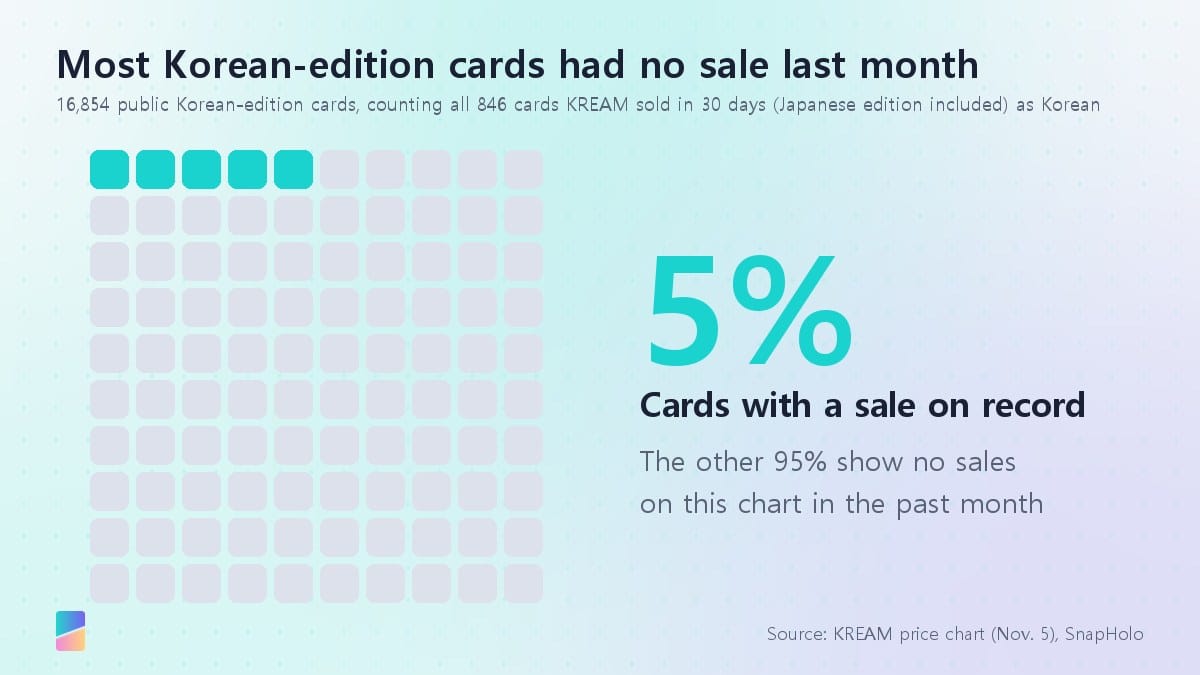
A stock trades all day, so you can trust its quote. Cards work differently. KREAM's price chart shows 846 ungraded Pokémon cards traded over the 30 days through Nov. 5, 2026, Japanese editions included, with a total volume of 4,845 trades. SnapHolo lists 16,854 Korean-edition cards alone, so even if all 846 were Korean edition, that would cover 5%. The other 95% have no trades on this chart in the past month.
You could ask whether those cards trade somewhere other than KREAM, so we also checked Pokepolio, which collects community trades too. Its top card for trades this week, the Korean-edition Giratina V 111/100, has 37 sales collected over about 8 months, and only 12 of them are ungraded. The same page lists a recent ungraded median of ₩200,000 in the table at the top and a sold median of ₩310,000 in the commentary below. With so few sales, the number moves a lot depending on which ones go into the calculation.
Pokémon card price rankings have the same problem. The Korean-edition Mega Charizard X ex MUR jumped 55.8% from the previous day on KREAM's chart, on a listed volume of 12 trades. The ₩1,799,000 on the Korean-edition Mega Charizard Y ex MUR, No. 1 in Collectory's price rankings, turns out to be an asking price once you open the card page, and the last real sale was ₩1,050,000, 126 days ago. Collectory says so plainly on the card page, but the ranking table shows only the amount.
Charizard 137, which nearly matched at all three places in the table above, is the opposite case. Pokepolio has 31 sales for it, and the SnapHolo value changed recently. When a card trades often, prices converge even across markets, but few cards trade that often.
Korean Pokémon card price sites compared
SnapHolo has prices on 11,327 Korean-edition cards, 13 times the 846 cards KREAM traded in 30 days. Those prices can't all be sold prices from this month. As our pricing guide explains, we pick one value as the reference price, taking real sales first, then market indicators, then seller asking prices. That leaves fewer cards with no price, but the basis of the price differs from card to card.
This is also why SnapHolo came out highest on so many cards in the table above. The 30th Celebration set has been sliding since its release on Sept. 16, 2026, and Collectory reports that the reprint Lugia's median ungraded winning bid fell five weeks in a row, from ₩63,500 to ₩39,000. Yet the price history for SnapHolo's Korean-edition Pikachu ex 126/103 shows ₩52,000 unchanged from Oct. 8 to Nov. 2. On Pokepolio, an ungraded A-grade copy of the same card sold for ₩30,000 on a Naver Cafe board on Nov. 4. At that point the SnapHolo value was stale.
If you want to know which price site to use, here is how we rate them.
| Price site | What it shows | Market, date and count | Our take |
|---|---|---|---|
| Pokepolio | Korean-edition sold prices, values by condition | Source, date and count all shown | First stop for buying or selling Korean-edition cards. For this job it beats SnapHolo |
| KREAM price chart | Median sold price on KREAM, values by grade | Market and 30-day volume shown, no card numbers | The most honest, but narrow. It can't separate two cards with the same name |
| Collectory | Current price, last sale, asking-price label | Shown next to the value, some charts and history need an account | Good at labeling asking prices and comparing countries. The big number can be an asking price |
| SnapHolo | One ungraded reference price, table by grade | Reference date and price history shown, no sale count | Use it to find a card by photo or total a collection, not as a trading benchmark |
| TCG Vault | English-edition TCGplayer prices in dollars | Market named | English edition only. Don't apply it to Korean-edition cards |
| Bunjang, Karrot | Listing asking prices, sold posts | Photos of the real card | Good for comparing condition. A listed price is a price that hasn't sold |
Price apps get the same test. If you can't see whether an app's number is a sale or an asking price, you can't use it for a trade. ICU.GG, recommended for Korean-edition prices by the blog post that ranked first on Google, wouldn't load on four tries on the afternoon of Nov. 6, 2026, returning connection error 521. Sisemon, which had ranked third on Google, showed a "service has been discontinued" screen. The outage could be temporary, but if you rely on one site from a recommended list, a day like that leaves you with no price at all.
Japanese Pokémon card prices and currency conversion
When a Korean-edition card has no record, many people convert the Japanese-edition price, and the result doesn't hold up. KREAM's chart puts the two editions side by side on the same platform in the same condition.
| 30th Celebration card (KREAM Ungraded A median sold price, Nov. 5, 2026) | Korean edition | Japanese edition | Korean ÷ Japanese |
|---|---|---|---|
| Charizard RH | ₩63,000 | ₩138,000 | 46% |
| Lugia RS | ₩44,000 | ₩125,000 | 35% |
| Mew ex FUR | ₩26,000 | ₩54,000 | 48% |
| Mewtwo ex FUR | ₩20,000 | ₩41,000 | 49% |
That doesn't mean you can just halve the Japanese price. Across 55 ungraded SAR pairs that SnapHolo links as the same card, the Korean edition's median value is 0.66 times the Japanese edition's, but in 27% of pairs the Korean edition costs more. The answer you see on Naver Knowledge iN, that "Korean editions are worth almost nothing," is wrong too: the recent ungraded median for the Korean-edition Giratina V 111/100 on Pokepolio is ₩200,000. The person converting Japanese prices and the person calling Korean cards worthless are both judging a card by another market's numbers.
PSA grading and Pokémon card prices
These are recent medians for Korean-edition cards as shown on Pokepolio on Nov. 6, 2026.
| Card | Ungraded | PSA 9 | PSA 10 |
|---|---|---|---|
| Mega Charizard X ex MUR 116/080 | ₩250,000 | ₩204,000 | ₩807,000 |
| Mega Charizard X ex SAR 110/080 | ₩155,000 | ₩150,000 | ₩400,000 |
| Giratina V 111/100 | ₩200,000 | ₩250,000 | ₩580,000 |
| Mew ex SAR 205/165 | ₩90,000 | ₩99,000 | ₩280,000 |
| Mega Gengar ex SAR 240/193 | ₩104,000 | None | ₩225,000 |
Across these five cards, PSA 10 runs 2.2 to 3.2 times the ungraded value and PSA 9 runs 0.8 to 1.25 times. Each PSA grade has only 1 to 15 sales, so these aren't precise figures, but the direction is clear. PSA 10 is what lifts the value, and a PSA 9 usually just costs you the grading fee. That's why you shouldn't send a card in after looking only at the PSA 10 price.
The multiple alone misleads too. Among the 97 Japanese-edition cards on SnapHolo with at least 3 PSA 10 sales in 30 days, PSA 10 was 3.5 times the ungraded value for cards at ₩10,000 to ₩50,000 ungraded, 2.4 times at ₩50,000 to ₩200,000, and 1.8 times at ₩200,000 and up. Cheaper cards have bigger multiples, but expensive cards leave you more money. No Korean-edition cards in our data meet the same conditions, so these multiples don't carry over to them.
Old Pokémon card values
"How much is this Pokémon card worth?" questions on Naver Knowledge iN often involve old cards someone found at home. One 2019 answer even says the longer you hold them, the more they will "shoot up like a stock, guaranteed." As of Nov. 6, 2026, the 851 Korean-edition cards released before 2015 that have a SnapHolo reference price have a median of ₩2,000, and 1.9% are worth ₩100,000 or more. That count includes only cards with a price, and some of those prices aren't sold prices. If a card has no sale record even when you search by number, it has no set value. The value gets set when someone shows up to buy it.
Uses of a reference price
You could still argue that a card needs some number. That's fair, and it's why we show prices on cards with only one or two sales. Without a value you can't total a collection, and a total tells you the rough size of everything you own. If you stick to one site and total with its values alone, you can also read the trend.
That's as far as this number goes. A reference price can give you a rough idea of your collection's size, but it can't decide what to pay for this one card today. The same goes for SnapHolo's own values.
Rules for reading and setting Pokémon card prices
The default is the sold price from the last 30 days for the same number in the same condition. For a Korean-edition card, read the sales one by one on Pokepolio, and if KREAM has the same card, put the two values side by side. Whether you're buying or selling, use the lower of the two. If you price a Pokémon card from asking prices, the listing usually won't sell. Selling to a shop goes lower still. This post on high-end cards at Japanese card shops found that buyback prices in August 2026 were 56% to 73% of selling prices. We found no public data measuring Korean card shops the same way.
If a card has fewer than 5 sales in the last 30 days, we treat it as having no market price. The 5-sale line is our own call, and no data proves it's the right boundary. A card like that is worth what the seller and buyer agree on, and "cheaper than market" has nothing behind it.
We ignore asking prices on listings, amounts in ranking tables, Japanese prices converted at the exchange rate, values with no count or date, and values stuck at the same amount for weeks. SnapHolo values fall under that last one too. The reference date on a card page is the last day we checked it, so look at the price history below it to see when the value last changed.
We don't buy when a set less than two months old is still falling, when the seller's price is above the high end of recent sales, or when the only reason given for a card with no sale record is that it's "cheaper than market."
We also have rules for when not to grade. We skip cards with flaws you can see with the naked eye, where PSA 10 is no sure thing, and cards where even a PSA 10 wouldn't leave any money after the grading fee and shipping. Grading fees vary by submission service and by season, so we left the amounts out of this article.
These rules can be wrong. A heavily traded card like Charizard 137 has a market price, and the sites barely differ on it. If many deals happen where sites can't see them, such as in card shops, our counts are lower than the real number of trades. As Korean-edition trading grows, more cards will have a market price. Until then we won't trust a number with no count or date.
As for the Mew ex FUR from the start, we wouldn't buy it at ₩40,000. On Nov. 5, 2026, the KREAM median sold price was ₩26,000, the Pokepolio value was ₩38,000 on a record of 25 sales, and the set is still falling. We left the ₩45,000 SnapHolo value out of the decision.
If you don't know your card's number, find it with card scan, then check the price history first in prices by set and price movers.
Methods and sources
- Period: Site values are copied as displayed on the afternoon of Nov. 6, 2026, KST. The KREAM chart is dated Nov. 5, 2026, and covers the last 30 days. Values will change after that.
- Price types: KREAM is the median sold price, Pokepolio is the recent Raw median (sold), and SnapHolo is one reference price chosen from the last 30 days of observations, which is neither a mean nor a median. These are different kinds of values, so the gaps between them aren't errors in themselves.
- Korean vs. Japanese comparison: From 6,851 pairs with prices on both sides, we kept pairs with the same rarity, ₩5,000 or more on both sides, a gap within 10 times, and a freshly observed Korean-edition value, then used the 55 SAR pairs.
- Grading multiples: 97 Japanese-edition Pokémon cards with at least 3 PSA 10 sales in 30 days and a freshly observed ungraded value of ₩10,000 or more.
- Excluded: Values where the same amount appears on several cards, values with a doubtful edition match, edition ratios for sets from before 2022, and 9 cards under ₩10,000 from the grading multiples.
- Sources: KREAM Pokémon card price chart, Pokepolio, Collectory, TCG Vault, SnapHolo pricing guide, Japanese card shop comparison post.
- The judgments in this article are the editors' opinions. They are not advice to buy or sell, and they do not guarantee any return.


