

A collector who paid more than $660,000 for a PSA 10 Shiny Rayquaza now says the graded case was counterfeit, while the Pokémon card inside it is real. Dexerto reported the claim on November 3, 2026, based on Jesse Peng's own YouTube video .
What did Jesse Peng say was fake about his $660,000 Rayquaza?
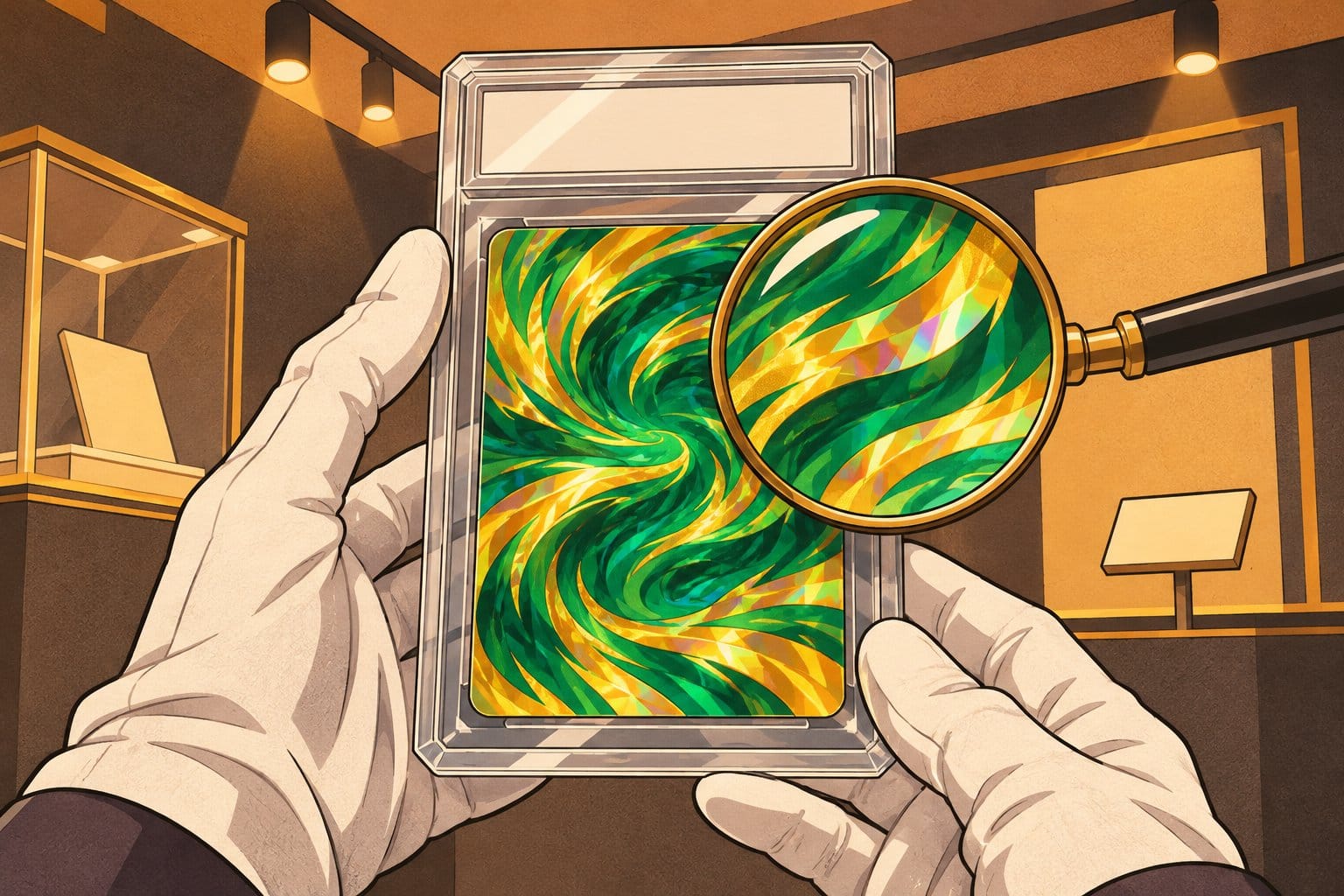
Jesse Peng says the PSA slab (the sealed plastic case and label) was fake, not the card. According to Dexerto, he paid over $660,000 for a copy of the 2011 Call of Legends Shiny Rayquaza SL10 graded PSA 10 . In his account, the ink on the case gave it away.
Quick Answer: Collector Jesse Peng says the PSA 10 slab holding his Call of Legends Shiny Rayquaza SL10 was counterfeit. He bought it for over $660,000, according to Dexerto (November 3, 2026). Peng says the card and the label are genuine and the slab's fugitive ink is wrong. PSA has not commented.
Dexerto's headline calls the "dream card" fake. The article itself is narrower. It quotes Peng saying the Pokémon card and the PSA label are authentic, and that only the case failed his check:
"The card is real, the label is real, the only thing that they couldn't do is get the fugitive ink right," — Jesse Peng, collector, whom Dexerto describes as the owner of PDGR (source: Dexerto)
Dexerto credits Peng's video, "A $660,000 Pokémon slab that turned out to be fake.", as its source. In that video Peng says Shiny Rayquaza SL10 had been his long-time chase card.
What is and isn't confirmed:
- Reported: the over-$660,000 price, the PSA 10 grade and the fake slab. Each comes from Peng, as reported by Dexerto .
- Not confirmed: PSA has not commented on this case as of November 5, 2026. Dexerto does not name the seller or the middleman.
- Tracked: Slab Watch lists it as a "suspected fake PSA 10-style slab," dated November 2026, with no cert number .
For now this is one collector's claim, reported by one outlet. It is not a finding by the grading company.
How did the purchase happen and what looked right at first?
Peng told Dexerto that he bought the PSA 10 Shiny Rayquaza through "a well respected middle man" in the TCG world. According to Dexerto, nothing about the sale looked wrong at first. The problem showed up only when the slab was checked after the purchase . Dexerto does not name the middleman.
The card itself is a well-documented chase card. Rayquaza SL10 is the Shiny-subset Rayquaza from Call of Legends, a Pokémon TCG set released in 2011. The Sports Card Investor price guide lists the PSA 10 copy as "2011 Call of Legends Shiny Rare SL10" . Dexerto reports that Peng had been chasing this card for a long time before he paid more than $660,000 for a copy graded PSA 10 .
Peng said the slab passed his first look:
"It looked like a very clean card and the label looked very very real," — Jesse Peng, collector, as quoted by Dexerto (November 2026)
According to Dexerto's account, three things made the sale look legitimate at the start:
- The channel: the deal went through a middleman Peng called well respected in the TCG world.
- The card: Peng described the Rayquaza inside the case as very clean. He later said the card is real.
- The label: the PSA 10 label looked "very very real" to him.
Peng's video, which Dexerto cites as its source, shows the same order of events: first the purchase, then the doubts (YouTube: "A $660,000 Pokémon slab that turned out to be fake."). Neither the video nor Dexerto gives the sale date, the payment method or how much the middleman was paid. Slab Watch lists the case only as a collector claim covered by gaming press .
Peng says the fake is the PSA case, not the Rayquaza card. A slab is the sealed plastic case a grading company puts around a card, with a label showing the grade and cert number. That is why the sale looked fine at first: a real card in a convincing case would pass a quick look, even from a careful buyer working through a trusted middleman .
How was the slab caught? Peng's PDGR check and the fugitive ink
Dexerto reports that the slab was caught by Peng's own verification system and by the label's fugitive ink. The ink on the case did not match the ink on genuine PSA slabs already in his collection . The card was not flagged. Only the case was.
According to Dexerto, Peng runs PDGR, an app with verification technology. Dexerto says his system flagged the slab as fake. Peng's comment on the case was: "This is so clean that it's a little bit suspicious to me" . In other words, the slab looked almost too clean to be real.
PDGR's own homepage describes something different. It calls PDGR ("Pedigree") "The Collectibles Registry" and says it launches in 2027, with an early-access waitlist . The site lists these features:
- Ownership records that stay with each collectible
- Provenance timelines covering ownership, sales and key events
- Tracking of slabs and portfolio value
The PDGR site lists Peng as a featured collector, "President of the TCG Hall of Fame." It does not call him the owner, and it does not mention detecting fake slabs . The "owner" description comes from Dexerto. Peng's link to a verification business is worth keeping in mind when reading his claim.
The ink check was the key step. Peng compared the label on the Rayquaza slab with labels on PSA slabs he already trusted, and the fugitive ink did not match. He says the card and the label print were otherwise convincing, so the ink was the part the counterfeiters did not get right .
Peng makes the same point in a YouTube video titled "A $660,000 Pokémon slab that turned out to be fake." Dexerto names this video as its source . Dexerto's report does not give the channel name or the upload date. As of November 5, 2026, PSA has not commented on the slab.
What is fugitive ink on a PSA label?
Fugitive ink is a security ink that dissolves when cleaning chemicals touch it. Checks use the same anti-washing ink. PSA prints it on the front and back of its labels so that a real label cannot be washed and reprinted. PSA introduced it as part of its LightHouse label redesign in 2017 . According to PSA's article on the new label, the ink is one of several layered features.
The ink's job is to block one specific method. A counterfeiter who takes a genuine label and tries to strip or alter it with solvents will damage the fugitive-ink print. To get past that, a fake has to recreate the ink from scratch. In Peng's case, Dexerto reports that this is where the copy failed: the ink on his slab did not behave like the ink on other PSA slabs he owns .
The 2017 LightHouse label described by PSA has these security features :
| Feature | What it is | What a buyer can check |
|---|---|---|
| Fugitive ink | Anti-washing ink printed on the front and back of the label | Compare it with labels on known-genuine PSA slabs |
| LightHouse hologram | Hologram that switches on and off when tilted | Tilt the slab and watch for the on/off effect |
| UV-reactive PSA logo | PSA logo that shows under ultraviolet light | Shine a UV light on the label |
No single feature on the table proves a slab is real. A cert number lookup also has a limit: it confirms that a certificate exists, not that a given case is the one PSA sealed. In October 2026 the tracker Slab Watch listed a case where a collector said his 2002 Expedition Dragonite PSA 10 shared a cert number with a copy sold at auction for $288,000 . That claim has not been confirmed.
Checks a collector can run on a high-value slab before paying:
- Look at the fugitive-ink print under magnification and compare it with a slab you know is genuine.
- Tilt the label to confirm the hologram switches on and off.
- Check the label under UV light for the PSA logo.
- Look up the cert number, keeping in mind that a match alone does not prove the case is genuine.
Peng's account suggests that a careful fake can pass a visual check. In his words, the label "looked very very real" until the ink was examined .
What does Dexerto report about the seller and the money?
According to Dexerto, Peng found that the seller held just under $2 million in cryptocurrency. That total includes Peng's $660,000 and money from other sales . Dexerto does not say how Peng traced those holdings or which other sales the money came from.
Dexerto's November 3, 2026 report leaves several things out :
- Seller: not named. The middleman who handled the sale is not named either.
- Police: no police report or law-enforcement contact is mentioned.
- Funds: nothing is said about getting any of the $660,000 back.
- PSA: as of November 5, 2026, the grading company has made no public statement on the case.
Peng's own account is in his YouTube video, "A $660,000 Pokémon slab that turned out to be fake." Dexerto names that video as its source. The case has not been independently confirmed. The seller has not responded in public.
The fake-slab tracker Slab Watch (fakeslabs.com) lists the case as a "Suspected fake PSA 10-style slab," dated November 2026 . Its entry describes a collector's claim that a 2011 Call of Legends Shiny Rayquaza bought for over $660,000 failed a fugitive-ink check. It labels this a claim reported in gaming press without PSA confirmation, and it lists no cert number.
The money figures should be read with that in mind. The $660,000 price and the "just under $2 million" in cryptocurrency come from Peng, as reported by Dexerto. No court filing, exchange record or PSA document has backed them up so far.
What did Peng say about the hobby afterward?
Peng told viewers that the case had shaken his commitment to collecting. Dexerto reports that part of him wants to quit. It also reports that he plans to fight counterfeit slabs with his own app and verification technology .
"Greed has destroyed our hobby over the last few months and this is not the hobby that I fell in love with 25 years ago," — Jesse Peng, collector, quoted by Dexerto
Dexerto describes Peng as the owner of PDGR. It says he has the resources to fight the problem and is "coming after you scammers" . PDGR's own homepage describes the company as "The Collectibles Registry" and says it will launch in 2027. The homepage lists Peng as a featured collector but does not call him its owner . Readers should keep in mind that Peng has a commercial stake in verification tools.
Dexerto's article also brings in a separate story to show how other fraud is affecting high-value Pokémon cards:
- The FBI has been investigating thieves who use fake credit cards to buy expensive Pokémon cards, according to Dexerto .
- Several stores in New Jersey were targeted. News 12 New Jersey reported an FBI warning to card shops on October 29, 2026 .
- Dexerto presents the FBI investigation as a separate matter. Nothing in its reporting connects it to Peng's Rayquaza slab.
Is this the only fake-slab case on record this autumn?
No. Slab Watch (fakeslabs.com) tracks reports of suspected fake grading slabs, and it lists one other high-value Pokémon case from this autumn. It files Peng's Rayquaza as a "Suspected fake PSA 10-style slab" dated November 2026. It describes the claim as a collector report carried by gaming press, with no confirmation from PSA and no cert number listed .
The earlier entry is from October 2026. A collector says he owns a 2002 Expedition Dragonite slab graded PSA 10 that has the same cert number as a copy sold at auction for $288,000. Slab Watch notes that this claim is also unconfirmed. The auction platform reportedly said it was investigating .
| Case | Date listed | Reported price | Problem reported | Status |
|---|---|---|---|---|
| 2011 Call of Legends Shiny Rayquaza SL10, PSA 10 slab | November 2026 | Over $660,000 (per Dexerto) | Fugitive ink on the label failed a check | Suspected; not confirmed by PSA |
| 2002 Expedition Dragonite, PSA 10 slab | October 2026 | $288,000 (auction sale of the matching cert) | Same cert number as another slab | Collector report; unconfirmed |
The table lists only what Slab Watch and Dexerto report . Two listed cases do not show how common fake slabs are. PSA has not issued a public statement on either one.
The two reports point to different checks. In the Rayquaza case, the label's physical security feature, fugitive ink, was the problem. In the Dragonite case, the problem was a cert number that showed up on two slabs. Buyers looking at a high-value Pokémon slab can do both: check the label's physical features and compare the cert record against previous sales. The Slab Watch list is one place to see whether a specific slab has already been reported.
Frequently asked questions
Was the Shiny Rayquaza card itself counterfeit?
No. Dexerto quotes collector Jesse Peng as saying "The card is real, the label is real, the only thing that they couldn't do is get the fugitive ink right" . Peng says the PSA case (slab) is the fake. The Pokémon card inside it is genuine.
How much did Jesse Peng pay and for which card?
According to Dexerto, Peng paid more than $660,000 for a Shiny Rayquaza SL10 from the 2011 Pokémon TCG set Call of Legends, in a slab labelled PSA 10 . The deal went through a middleman Peng described as "well respected" in the TCG world.
What is fugitive ink on a PSA label?
Fugitive ink is an anti-washing ink, the same kind used on checks. It dissolves when cleaning chemicals touch it. PSA lists it as a security feature of its LightHouse label, printed on both the front and the back. PSA also lists a hologram that changes when the label is tilted and a logo that shows under UV light. Peng says the fugitive ink on his Rayquaza slab did not match the ink on genuine PSA slabs in his collection.
Has PSA confirmed the slab is fake?
No. As of November 5, 2026, PSA has not made a public statement on the case. The tracker Slab Watch lists it as a "Suspected fake PSA 10-style slab" dated November 2026 . Slab Watch describes it as a collector's claim reported in gaming press, with no confirmation from PSA.
Who was the seller?
Dexerto does not name the seller or the middleman. It reports that the seller held just under $2 million in cryptocurrency, which included Peng's $660,000 plus money from other sales . Dexerto does not mention any police report or lawsuit over the sale.
Related Articles
- A Gwangju esports cup adds a Pokémon Card Game bracket
- Pokémon Happy Meal cards come loose in the box, not in packs
- Delta Reign lands Nov 6 with Mega Rayquaza ex and 30th sets
- Amazon drops the 30th Celebration Poster Collection to $41.47
- Nov 27's Pokémon TCG set is Japanese-only, not English
Latest Pokémon set prices on SnapHolo
| Card | Edition | Rarity | SnapHolo price |
|---|---|---|---|
| Mew R | English | RGB Rare | $4,461.95 |
| Mew B | English | RGB Rare | $4,243.91 |
| Mew G | English | RGB Rare | $3,529.24 |
| Mew ex 152 | English | Special Illustration Rare | $64.93 |
| Gengar ex 154 | English | Special Illustration Rare | $59.40 |
| Pikachu ex 150 | English | Special Illustration Rare | $50.74 |
| Mew ex 158 | English | Futuristic Rare | $43.66 |
| Mewtwo ex 151 | English | Special Illustration Rare | $39.53 |
| Sylveon ex 153 | English | Special Illustration Rare | $38.27 |
| Pikachu ex 149 | English | Special Illustration Rare | $36.12 |
| Jirachi ex 155 | English | Special Illustration Rare | $33.59 |
| Mewtwo ex 157 | English | Futuristic Rare | $27.76 |
| Greninja ex 148 | English | Special Illustration Rare | $16.70 |
| Salamence ex 156 | English | Special Illustration Rare | $12.92 |
| Fuecoco ex 147 | English | Special Illustration Rare | $11.14 |
| Maushold 146 | English | Illustration Rare | $7.79 |
| Meowth 144 | English | Illustration Rare | $5.88 |
| Alolan Meowth 139 | English | Illustration Rare | $4.65 |
| Galarian Meowth 141 | English | Illustration Rare | $4.15 |
| Moltres 130 | English | Illustration Rare | $3.96 |
Ungraded card prices as of 2026-11-05 (KST).
Sources: Dexerto · "A $660,000 Pokémon slab that turned out to be fake." · Slab Watch · PDGR site · PSA · Dexerto (2) · News 12 New Jersey


